The Feynman Technique: Why the Best Tutors Teach Like Physicists
Learn how explaining concepts in simple language accelerates understanding — a method ancient scholars used long before Feynman put his name on it.
The Feynman Technique: Why the Best Tutors Teach Like Physicists
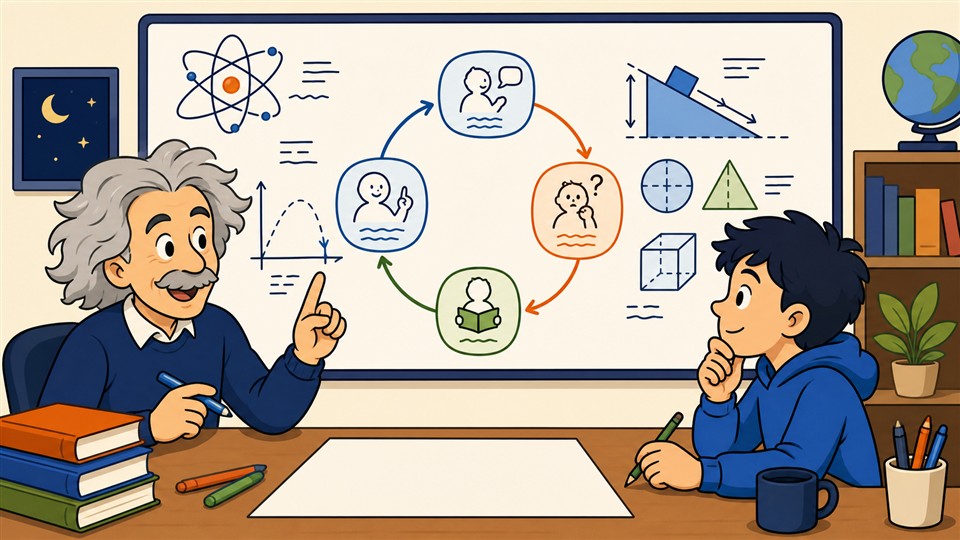
When Richard Feynman, the Nobel Prize-winning physicist, wanted to truly understand a concept, he didn't reach for more textbooks. He reached for a blank sheet of paper and wrote the topic at the top. Then he tried to explain it — as if teaching a curious child.
If he stumbled, he knew exactly where his understanding was weak. He went back, studied that gap, and tried again. This simple loop — explain, identify gaps, fill them, repeat — became known as the Feynman Technique.
Why It Works
The human brain doesn't store information like a hard drive. It stores it like a web. When you force yourself to explain a concept in plain language, you're not just retrieving facts — you're actively weaving new connections between ideas.
Research in cognitive science supports this. A 2014 study published in Learning and Instruction found that students who taught material to others performed significantly better on retention tests than those who simply re-read notes.
How Tutors on TutorKamun Use This
Our most effective tutors don't lecture. They ask questions. They invite students to explain concepts back to them — often using the interactive whiteboard to draw diagrams, map processes, or write out steps in their own words.
When a student says, "I understand it, I just can't explain it," a good tutor hears an alarm bell. True understanding and the ability to explain are inseparable.
Try It Yourself
Next time you're stuck on a topic:
- Write the concept name at the top of a page.
- Explain it in simple terms, as if to a 12-year-old.
- Identify where you get stuck — that's your gap.
- Go back to your source material and close the gap.
- Simplify your language further. Use analogies.
The ancients called this pedagogy — the art of leading a child to knowledge. Feynman just reminded us that it works for adults too.
Enjoyed this article?
Share this wisdom with students, parents, and fellow educators.