The Promise and Pitfalls of AI in Education: How to Harness AI for Responsible Self-Learning
AI is revolutionising how students study independently, but using it incorrectly can stifle critical thinking. Discover how TutorKamun provides responsible guidance and unique content for an optimal AI-led experience.
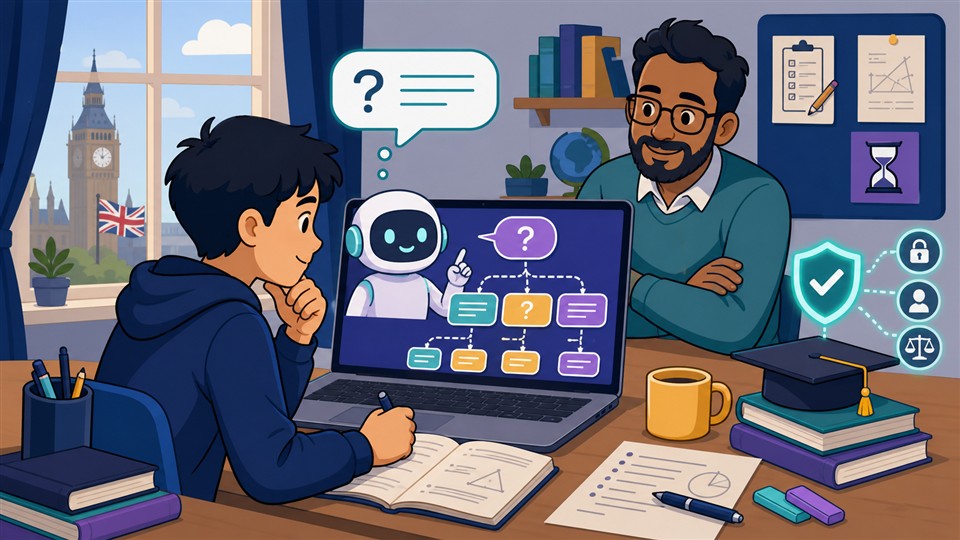
The Promise and Pitfalls of AI in Education: How to Harness AI for Responsible Self-Learning
Artificial intelligence has transformed the educational landscape overnight. Students no longer have to wait until the next school day or weekly tutoring session to get an answer to a burning revision question. With AI tools available around the clock, self-directed learning is more accessible, responsive, and adaptable than ever before.
However, as with any powerful tool, how AI is integrated into a student's study routine determines whether it builds true understanding or merely creates an illusion of competence.
The Promise: Supercharging Independent Study
When used effectively, AI acts as an infinitely patient study companion. It offers distinct benefits for independent learners:
- Instant Concept Breakdown: Complex topics in physics, organic chemistry, or calculus can be rephrased instantly at different comprehension levels until the concept "clicks."
- Personalised Practice Pace: Rather than working through generic worksheets, students can generate targeted practice questions that adapt to their specific areas of confusion.
- 24/7 Homework Guidance: Immediate feedback prevents students from getting stuck on step two of a ten-step problem, keeping momentum alive.
The Pitfall: The Danger of Cognitive Shortcutting
Despite these advantages, misusing AI presents significant risks to long-term academic success:
- Copy-Paste Learning: Relying on AI to generate completed essays or solve equations outright bypasses the cognitive effort required for memory consolidation. If the brain doesn't do the work, it won't retain the knowledge.
- Unverified Information and Hallucinations: Standard web AI models can occasionally produce convincing yet inaccurate facts or methods that diverge from standard UK exam board requirements (such as AQA, Edexcel, or OCR).
- Loss of Problem-Solving Resilience: When answers are available in seconds, students can lose the patience needed to wrestle with challenging multi-step problems — a crucial skill for top GCSE and A-Level performance.
The TutorKamun Approach: Guided, Responsible AI Learning
At TutorKamun, we believe AI should illuminate the path to understanding — not walk it for the student. We have designed our AI-led experience around two core pillars: responsible pedagogical guardrails and curriculum-aligned unique content.
1. Socratic Guidance, Not Answer Machines
Our AI tutors are trained to guide rather than simply prescribe. Instead of providing a ready-made answer, TutorKamun's AI prompts students with Socratic questions, helping them identify the next logical step and guiding them to uncover the solution themselves.
2. High-Quality, Curriculum-Aligned Proprietary Content
Generic AI models pull information from across the internet, leading to mismatched terminology or out-of-syllabus methods. TutorKamun grounds its AI in proprietary, expert-crafted learning materials specifically structured around national curriculum standards and exam board specifications.
3. Seamless Human-AI Synergy
AI is at its best when paired with human mentorship. When a student encounters a persistent conceptual roadblock during AI-led study, TutorKamun smoothly connects them with expert 1-to-1 human tutors who can dive deeper into nuance, build confidence, and provide emotional encouragement.
4 Best Practices for Responsible AI Study
If your child is using AI for revision, encourage these high-impact study habits:
- Use AI to Explain, Not Complete: Ask AI to "Explain the concept of momentum using an everyday analogy" rather than "Write my physics homework response."
- Verify Against Syllabus Standards: Always cross-reference AI-generated explanations with official specification checklists and trusted revision guides.
- Test Yourself Unassisted: After asking AI to clarify a topic, close the browser and solve a similar problem completely from memory to test retention.
- Combine AI Efficiency with Expert Human Feedback: Use AI for rapid daily practice, and leverage 1-to-1 human tuition for exam technique, essay structure, and deep diagnostic assessment.
By combining the speed of AI with responsible guidance and verified educational content, students can master self-directed study safely and effectively.
Enjoyed this article?
Share this wisdom with students, parents, and fellow educators.