How to Use the TutorKamun Whiteboard for Maximum Learning Impact
Visual learning unlocks comprehension barriers that text alone cannot. Discover six whiteboard techniques tutors use to transform abstract maths and science.
How to Use the TutorKamun Whiteboard for Maximum Learning Impact
The difference between a good tutoring session and a transformative one often comes down to one tool: the whiteboard. Not because it looks impressive, but because it turns passive listening into active construction.
On TutorKamun, our interactive whiteboard isn't just a digital canvas — it's a shared thinking space. Here's how our top tutors use it to create breakthrough moments.
1. The Step-by-Step Reveal
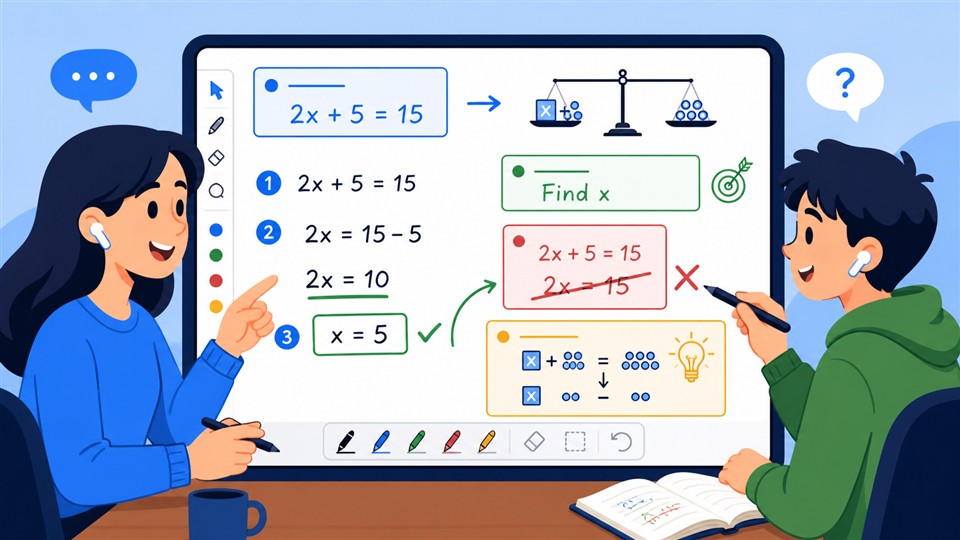
Instead of showing a complete solution, tutors write one step at a time and pause. They ask: "What do you think comes next?" This turns problem-solving into a dialogue, not a monologue. The whiteboard becomes a story that unfolds together.
2. Colour-Coded Logic
Our brains process colour before text. Smart tutors assign meaning to colours: blue for given information, green for the target, red for common mistakes, gold for key insights. Over time, students begin to "see" the structure of problems before they even read them.
3. The Wrong-Path Map
Some of the most powerful learning happens when tutors deliberately sketch an incorrect approach, then ask students to find the error. The whiteboard makes this visible and safe. Mistakes become shared artefacts to analyse, not shameful secrets to hide.
4. Diagram-First Thinking
In physics and geometry, students often rush to equations. Great tutors insist on a diagram first. "Draw what you see," they say. The act of visualising forces, angles, or relationships on the whiteboard activates spatial reasoning and often makes the equation obvious.
5. The Growing Summary
Throughout a session, tutors maintain a "key takeaways" box in the corner of the whiteboard. Every time a breakthrough occurs, they add a bullet. By the end, the student has a personalised revision sheet — automatically.
6. Student-Driven Annotations
The most underrated feature? Letting the student control the pen. When a student draws their own diagram or writes their own explanation, ownership shifts. They stop being a passenger and become the driver.
The whiteboard isn't magic. But used deliberately, it makes thinking visible — and visible thinking is learned thinking.
Enjoyed this article?
Share this wisdom with students, parents, and fellow educators.