Tailored Home Education: Unlocking Potential with 1:1 Online Tutoring for Neurodiverse & Independent Learners
Learn how personalised online tutoring supports neurodivergent and independent home learners through multi-sensory whiteboards, flexible pacing, and low-anxiety 1:1 engagement.
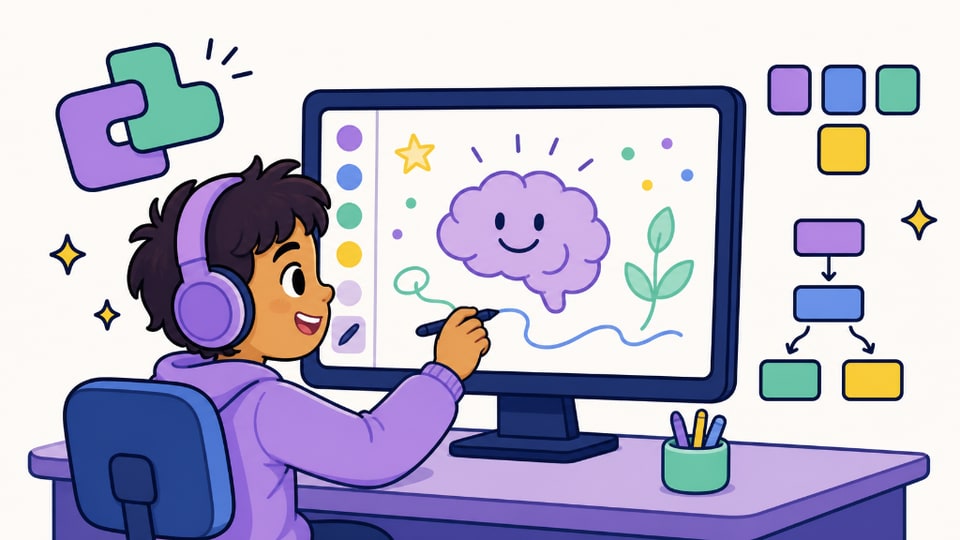
Tailored Home Education: Unlocking Potential with 1:1 Online Tutoring for Neurodiverse & Independent Learners
A significant and growing proportion of families turn to home education because the mainstream school environment struggles to accommodate neurodiverse minds. Whether a child is navigating ADHD, Autism Spectrum Condition (ASC), Dyslexia, Dyscalculia, Sensory Processing Differences, or School-Induced Anxiety, the rigid structures of a 30-person classroom can stifle their potential.
Home education provides the sensory sanctuary and individual freedom these learners need. However, unlocking their full academic potential often requires specialised pedagogical techniques.
Here is how modern 1:1 online tutoring pairs with home education to create a bespoke, empowering learning environment for neurodiverse and independent learners.
1. Why Traditional Classrooms Fail Neurodivergent Thinkers
Mainstream classrooms rely heavily on auditory lectures, uniform pacing, and rigid sitting arrangements. For neurodivergent children, this creates multiple barriers:
- Sensory Overload: Fluorescent lights, background chatter, and sudden bells deplete cognitive energy before learning even begins.
- Pacing Mismatch: Fast-paced curricula force students to move on before mastering foundational concepts, leading to anxiety and disengagement.
- The "Masking" Tax: Neurodivergent students often spend immense mental energy pretending to fit in, leaving little bandwidth for creative or academic problem-solving.
At home, in a familiar, comfortable setting, these stressors disappear. Adding a dedicated 1:1 online tutor transforms this safe space into an engine for academic confidence.
2. The Power of Dynamic Pacing and Hyper-Personalisation
In 1:1 online tutoring, there is no artificial school bell. The curriculum adapts to the student, never the other way around.
+-----------------------------------------------------------+
|               TRADITIONAL CLASSROOM PACE                  |
|  [Topic A] ---> [Topic B] ---> [Topic C]  (Rigid Dates)   |
+-----------------------------------------------------------+

+-----------------------------------------------------------+
|               1:1 BESPOKE DYNAMIC PACING                  |
|  [Topic A] ======> [Deep Mastery] ---> [Topic B (Quick)]  |
+-----------------------------------------------------------+
- Deep Dives for Fast Learners: When a child demonstrates intense passion (hyperfocus) for astrophysics or historical eras, a specialist tutor can accelerate the content beyond standard key stage boundaries.
- Patient Deconstruction for Sticking Points: If dyscalculia makes fractions difficult, a tutor can spend three sessions using visual fraction bars and interactive digital blocks until the lightbulb moment strikes.
3. Multi-Sensory Engagement Through Interactive Whiteboards
For visual, spatial, and kinesthetic thinkers, text-heavy worksheets alone are ineffective. Modern digital classrooms utilize interactive shared whiteboards that turn abstract principles into tangible experiences:
- Color-Coded Logic: Tutors use distinct colors to track steps in algebraic equations, grammar parsing, or chemical bonding diagrams.
- Collaborative Drawing: The student actively manipulates geometric shapes, drags and drops matching components, and annotates texts in real time.
- Session Playback for Revision: Students with working memory challenges or dyslexia can re-watch stroke-by-stroke whiteboard replays at their own pace, pausing whenever necessary.
4. Building Self-Efficacy with the 70/30 Active Participation Model
Effective tutoring for independent and neurodiverse learners avoids monologues. The most impactful sessions follow the 70/30 Rule:
- 70% Student Action: The learner talks, sketches hypotheses, tests solutions, and explains concepts in their own words.
- 30% Tutor Guidance: The tutor acts as an encouraging facilitator, asking probing Socratic questions and offering praise for resilient effort.
This continuous, low-stakes dialogue replaces the fear of "getting it wrong in front of the class" with the thrill of discovery.
5. Key Features to Seek in an Online Tutor for Neurodivergent Learners
When selecting an online tutor for your home-educated child, look for educators who demonstrate:
| Quality | Why It Matters for Neurodiverse Learners |
|---|---|
| Patience & Active Listening | Gives students the necessary processing time without rushing their thoughts. |
| Strengths-Based Approach | Celebrates their unique cognitive strengths rather than focusing solely on deficits. |
| Multi-Modal Explanations | Can switch seamlessly between visual diagrams, analogies, and step-by-step breakdowns. |
| Verified Safeguarding (Enhanced DBS) | Provides safety and professional accountability in every online interaction. |
Celebrating Every Learner's Unique Journey
Every child's mind works differently. When home education's nurturing environment is combined with the specialized support of an empathetic 1:1 online tutor, neurodivergent and independent learners don't just keep up—they flourish.
Enjoyed this article?
Share this wisdom with students, parents, and fellow educators.